

Besalú: The Smallest Town in Spain With One of the Most Intact Jewish Histories
You’ve probably never heard of Besalú. Most people haven’t. It’s a medieval town of about 2,000 people sitting in the volcanic landscape of the Garrotxa region, an hour north of Barcelona. And it contains something almost no one outside of serious Jewish history circles knows about: the only mikveh — ritual Jewish bath — in all of Spain that has been excavated and is open to visitors.
That alone makes it worth the trip.
What Makes Besalú Different
The Jewish community of Besalú was small by medieval standards, but it left a remarkable physical record. The mikveh, discovered in 1964 during construction work near the river, dates to the 11th or 12th century. It was carved directly into the bedrock, fed by the waters of the Fluvià River, and used for ritual purification for hundreds of years before the community was expelled.
You descend a narrow stone staircase to reach it. The space is tight, low-ceilinged, and completely intact. Standing inside, you’re in a room that hasn’t changed in 800 years. There’s no reconstruction, no replica, no museum version of the experience. Just the original stone, the same dimensions, the same walls.
For visitors with a strong connection to Jewish observance, it’s a genuinely affecting experience.
The Town Itself
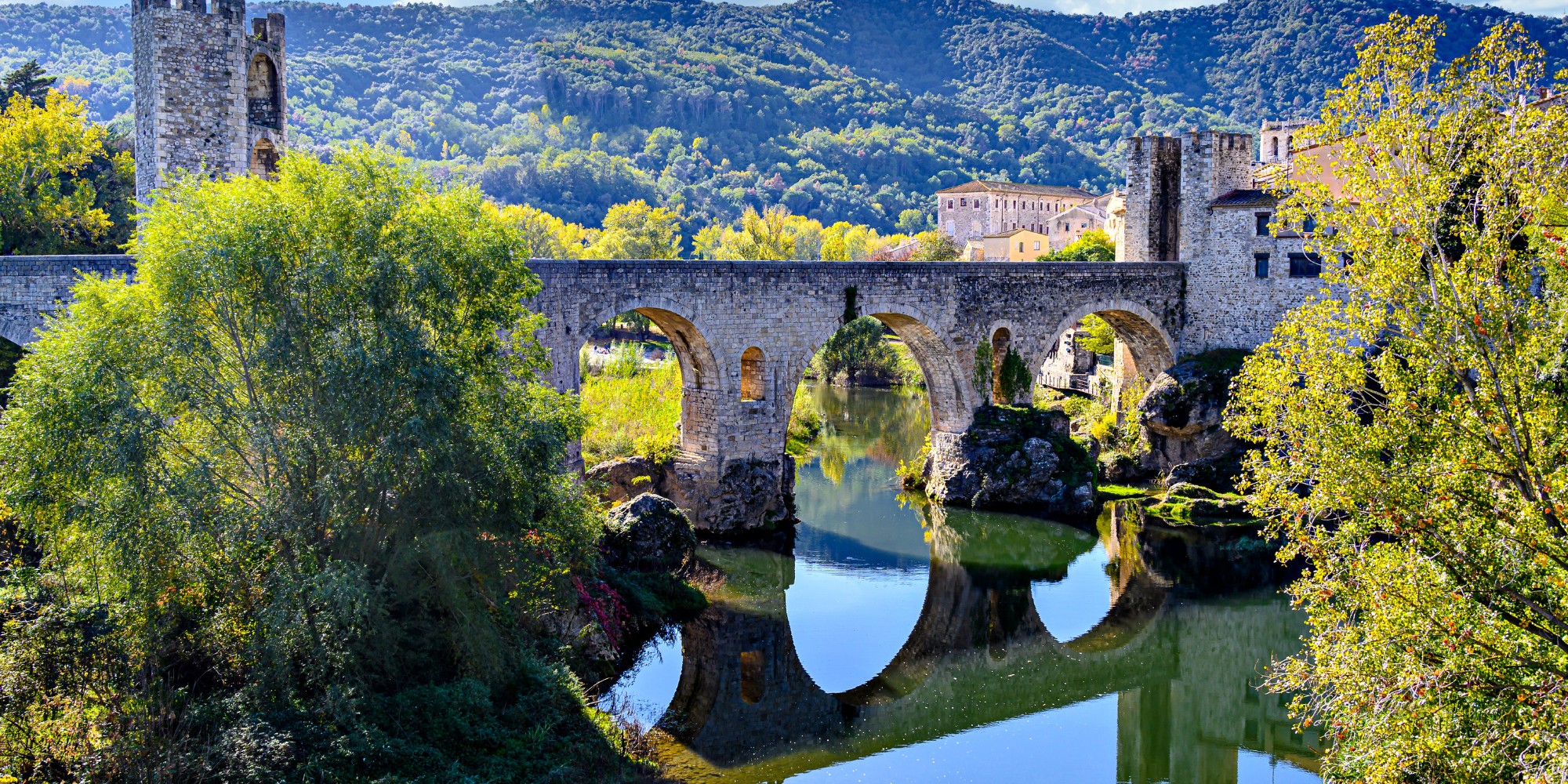
Besalú is also simply beautiful. The Romanesque bridge over the Fluvià, built in the 11th century, is one of the most photographed in Catalonia. The old town center is compact and walkable. And the pace of the place — quietly medieval, completely unhurried — is a sharp contrast to Barcelona’s energy.
Most visitors combine Besalú with a stop in Girona on the same day, making a Catalonian Jewish heritage circuit that covers two very different kinds of history: Girona’s deep intellectual and architectural legacy, and Besalú’s more intimate, physical connection to daily Jewish life.
Getting There and Visiting
Besalú doesn’t have a train station. Getting there requires a car or a private driver, which is part of why it stays off the typical tourist circuit. The mikveh itself is managed by the local tourist office and requires a guided visit by appointment — you can’t simply walk in.
That’s exactly why it works best as part of an organized private day trip rather than an independent excursion. The logistics are manageable, but they need to be arranged in advance.
Worth Knowing
The Jewish community of Besalú was expelled in 1492 along with all other Jews in Spain. But before that, for centuries, this small river town had an active, documented, practicing Jewish community — with a synagogue, a mikveh, and records of their daily lives preserved in the archives. A town this size, with this much surviving physical evidence, is genuinely rare anywhere in Europe.
If you’re building a Jewish heritage itinerary around Catalonia, Besalú should be on the list. Not as a footnote. As a destination.
